

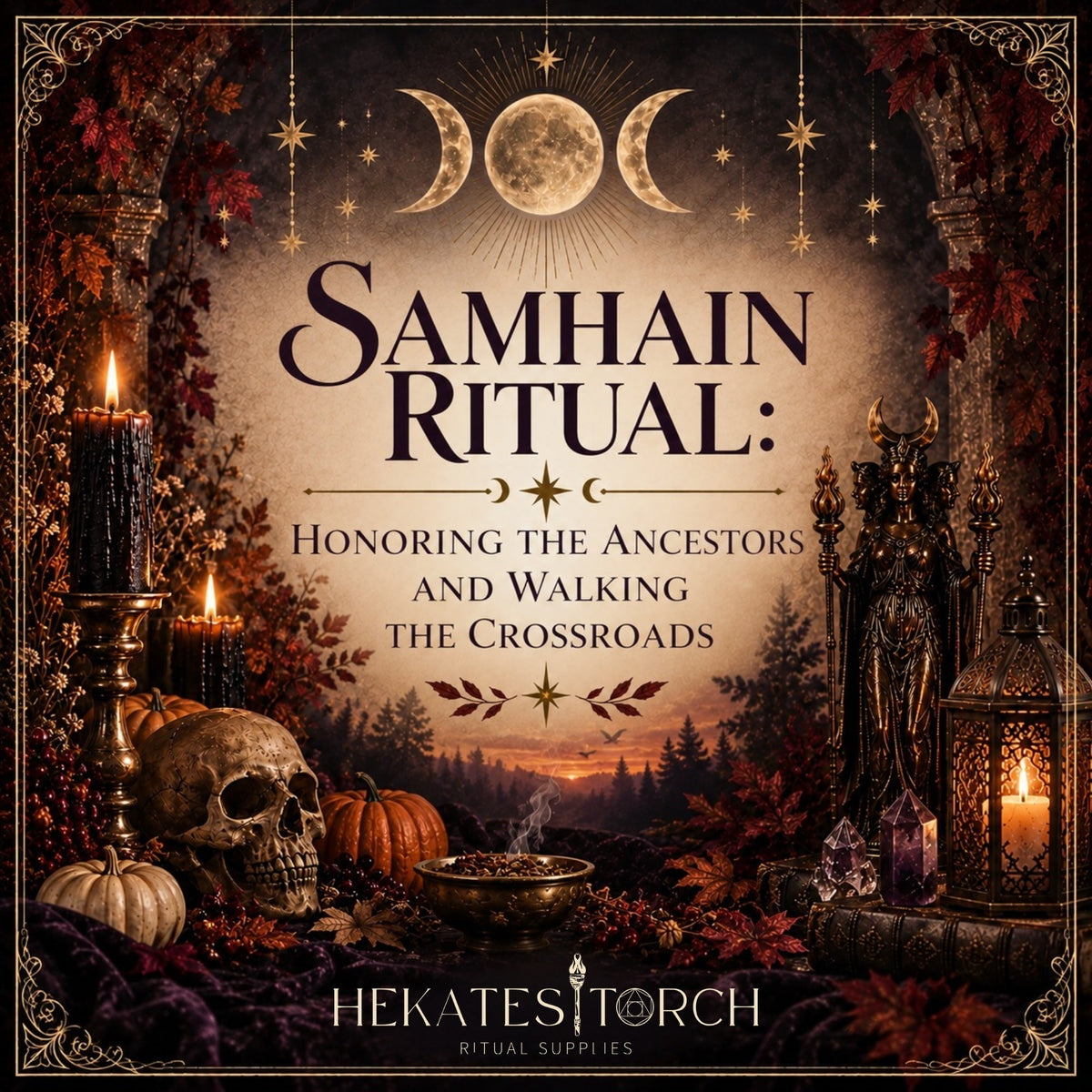
There comes a point each autumn when the world begins to grow quiet. The light changes. The evenings arrive earlier. Leaves fall from the trees, the harvest comes to its end, and the natural world begins its descent toward winter.
Samhain asks us to notice.
For witches and ritual practitioners, Samhain is traditionally a time associated with the dead, the ancestors, divination, remembrance, and the mysteries that exist beyond the visible world. It is often said that the veil between worlds grows thin during this season, making Samhain a powerful time for communion, spiritual journeying, and listening for what cannot always be heard in the noise of ordinary life.
But Samhain is not only about communicating with the dead. It is about our relationship with endings.
It asks us to remember those who walked before us, acknowledge what has passed from our own lives, and enter the darkness without immediately trying to fill it with something new.
There is wisdom in the pause between one cycle and the next. And there is perhaps no more fitting place to encounter that mystery than at the crossroads.
Hekate at the Crossroads
Hekate is a Goddess of crossroads, thresholds, keys, torches, spirits, and the roads between worlds.
At Samhain, these mysteries become especially meaningful.
The crossroads represents the place between what was and what will be. Behind us lies the road already traveled. Before us are paths we cannot yet fully see.
Hekate does not remove the darkness from that landscape. She carries the torch within it. That distinction matters.
Spiritual practice is not always about eliminating uncertainty. Sometimes it teaches us how to walk through uncertainty with awareness, discernment, and trust.
At Samhain, Hekate can be approached as Enodia, She of the Roads, and Phosphoros, the Light-Bringer whose torch illuminates the way through darkness.
Her keys remind us that some doors may be opened. Her torches remind us that we do not need to see the entire road to begin walking it.
And the crossroads reminds us that every ending eventually brings us to another threshold.
Entering the Sacred Dark
Modern spiritual culture often emphasizes manifestation, expansion, and becoming.
Samhain asks something different of us. It asks us to descend.
This does not mean seeking darkness for its own sake. It means becoming willing to sit with what is unfinished, hidden, grieving, forgotten, or ready to be transformed.
This is one reason Samhain is particularly suited to shadow work.
The shadow is not simply everything "negative" within us. It can contain the parts of ourselves we learned to hide, the truths we have avoided, the grief we never fully acknowledged, and even gifts or aspects of our power that we were once taught were unacceptable.
We do not enter the shadow to punish ourselves. We enter because there may be something there worth retrieving.
Samhain gives us permission to stop demanding immediate answers and instead ask:
What is ready to be seen?
Preparing Your Samhain Altar
Your ritual does not need to be elaborate to be meaningful.
Begin by cleaning the physical space and then cleansing it according to your own practice. Allow the preparation itself to become part of the transition from ordinary time into ritual time.
You might place photographs or tokens of the dead upon your altar, along with an offering, a key, a bowl, seasonal herbs or foods, and an image or symbol of Hekate. At the center, place a candle or lantern.
Our Samhain Ritual Candle can serve as the central flame of the altar, representing the torch carried into the mysteries of the season and the light that remains present even as we enter the sacred dark.
You may also wish to have your Ancestor Oil nearby for the ancestor portion of the rite. Then allow the altar to become quiet. It doesn't need to be filled with objects. Leave space for presence.
Who Are Your Ancestors?
Ancestor work at Samhain does not have to mean opening yourself indiscriminately to everyone in your biological lineage.
Death does not automatically make someone wise, healed, or appropriate to invite into your sacred space. Boundaries still matter. You may choose to honor beloved family members who have passed, but ancestry can also extend beyond blood.
There are ancestors of family, ancestors of spirit, ancestors of tradition, teachers who shaped the path before you, and people whose lives made your own life possible in ways they may never have known. You may even choose remembrance without communication.
Lighting a candle for someone does not obligate you to open a spiritual relationship with them. That distinction can make ancestor practice both more intentional and more meaningful.
A Samhain Crossroads Ritual
When you are ready, light your central candle. Allow yourself a few moments simply to arrive.
Feel your feet against the ground. Notice your breathing. Become aware of the room around you and the place where you are standing. Then open sacred space according to your tradition.
If you work with Hekate, call upon her at the crossroads. You may approach her as Enodia, She of the Roads, and Phosphoros, She Who Brings the Light.
Place an offering before her.
Then speak:
Hekate Enodia, Keeper of the Roads,
Hekate Phosphoros, Bearer of the Torch,
stand with me at this sacred threshold.
Illuminate what may be known,
guard what must remain beyond the gate,
and guide me as I walk between remembrance, mystery, and becoming.
Pause. Do not hurry into the next part of the ritual. Let yourself feel the threshold.
Remembering the Dead
If you are using Ancestor Oil, anoint yourself before beginning your ancestor work, or use the oil to anoint a candle dedicated to those you intend to honor.
Then begin speaking their names. One by one.
You might say:
I remember you.
I honor the life you lived,
the roads you walked,
and what has traveled forward through you.
Tell a story. Remember a laugh. Speak about something they taught you.
Place food, flowers, water, incense, or another appropriate offering before them.
You do not need to experience a vision, hear a voice, or receive a supernatural sign for the ritual to be meaningful.
Sometimes remembrance is the communion.
The Descent
Once you have honored the dead, allow the ritual to turn inward. Lower the lights if appropriate. Sit before your candle.
This is the point in the rite where you might meditate, journey, scry into water or a dark mirror, pull cards, cast bones, or simply close your eyes and listen.
Instead of asking what you should manifest next, ask:
What am I carrying that belongs to the road behind me?
Then:
What part of myself have I left in the dark?
And finally:
Is there something within that darkness I am ready to reclaim?
You do not need to answer every question. Samhain does not demand resolution. Sometimes recognizing the question is enough.
Release at the Crossroads
When you are ready, take a small piece of paper. Write down something that has completed its season in your life.
Perhaps it is a belief. A role. An expectation. An attachment. A way you once needed to survive but no longer need to carry.
Hold the paper and acknowledge that whatever you are releasing may once have served a purpose.
Then speak:
What has ended, I release.
I honor the road and walk in peace.
Wisdom gathered, lesson known,
I leave behind what I have outgrown.
Hekate, Torch upon the way,
Illuminate the path I take.
Safely burn the paper in a fireproof vessel, tear it, or dispose of it according to your practice.
Then stop. Don't immediately replace what you released with a new intention. Let there be space.
Listen Before You Leave
Sit before the flame one final time.
You may ask Hekate:
What do I need to understand as I cross this threshold?
Then listen. An answer may come immediately. It may come through divination. It may arrive in a dream several nights later. Or nothing may happen at all.
Ritual does not become unsuccessful simply because the unseen does not perform on command.
Sometimes the work is occurring in the silence.
Closing the Gate
When you feel complete, thank the ancestors you intentionally welcomed.
Thank Hekate for her presence and guidance.
Then deliberately close your ritual space according to your tradition. This is an important part of Samhain practice. Knowing how to approach a threshold also means knowing how to leave one.
Extinguish candles when appropriate. Clear your ritual space. Eat something. Drink water. Feel your body and the physical world around you again.
Return fully. The dead belong to the dead. The living must return to living.
Carrying the Torch Forward
Samhain reminds us that darkness is not empty.
Beneath the fallen leaves, the earth is already holding what will eventually become new life. Within grief lives memory. Within endings lives wisdom. Within the shadow may be pieces of ourselves waiting to be acknowledged and reclaimed.
We don't have to rush toward the next beginning. For one sacred night, we can remember.
We can descend. We can listen. And when it is time to return, we carry the torch with us.
The crossroads does not promise that we will see the entire road ahead. Only that there is another road.
And sometimes, one torch is enough to begin.
For Your Samhain Ritual
If you are preparing your own Samhain observance, you can explore our handcrafted Samhain Ritual Candle, Ancestor Ritual Oil, and other ritual supplies created to support remembrance, ancestor work, spiritual journeying, and intentional practice during the season.

Leave a comment
This site is protected by hCaptcha and the hCaptcha Privacy Policy and Terms of Service apply.