

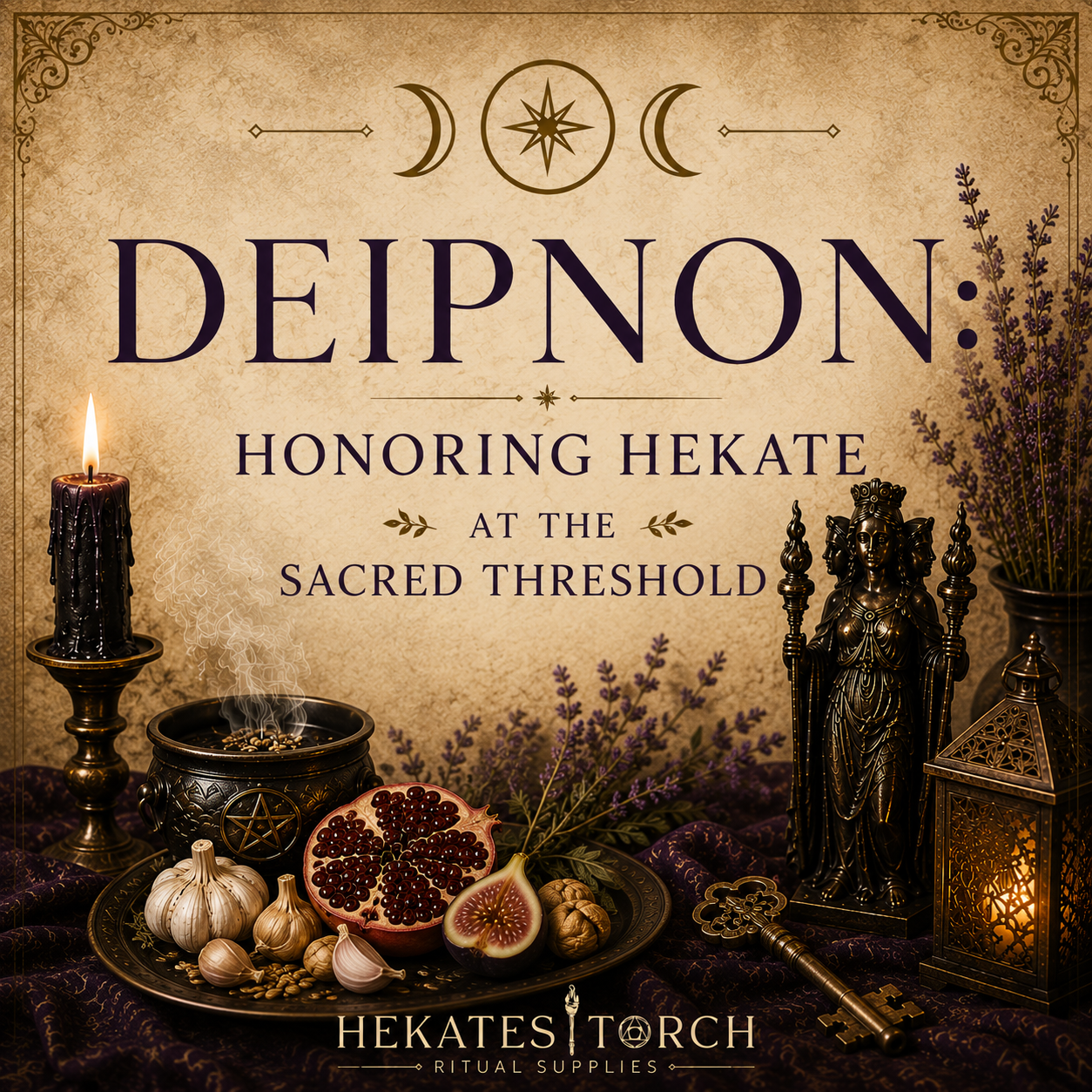
Each lunar month offers us an opportunity to begin again.
Before the first sliver of the New Moon appears in the sky, there is a night of profound stillness known as the Dark Moon. In the ancient Greek world, this evening was observed as Deipnon (pronounced DAYP-non), a sacred meal offered to Hekate at the crossroads. While simple in appearance, this monthly ritual became one of the most meaningful acts of devotion within Hekate's tradition.
Today, Deipnon continues to offer something just as valuable: a sacred pause between what has been and what is waiting to emerge. It is a time to reflect, express gratitude, release what no longer serves us, and consciously prepare for a new lunar cycle.
More than a ritual, Deipnon is an invitation into relationship—with Hekate, with the rhythms of nature, and with ourselves.
What Is Deipnon?
The Greek word deipnon simply means the evening meal. Traditionally, it referred to the final meal of the lunar month that was prepared and offered to Hekate before the New Moon.
In ancient Greece, families would cleanse their homes, prepare offerings, and leave them at crossroads or sacred places dedicated to Hekate. These offerings were not simply gifts. They acknowledged the closing of one cycle before stepping into another, honoring both the visible and invisible worlds that accompany us through life.
Although the practice has evolved, its heart remains the same. Deipnon reminds us that before we ask for something new, we first pause to acknowledge what has brought us to this moment.
More Than Leaving Food
One of the greatest misconceptions surrounding Deipnon is that it is simply about leaving food at a crossroads.
The offerings themselves are important, but they are not the true purpose of the ritual. An offering is a physical expression of an invisible relationship.
When we prepare food, light a candle, burn incense, or offer wine, bread, garlic, eggs, flowers, or prayers, we are participating in an ancient act of reciprocity. We recognize that spiritual relationships are nourished through gratitude, presence, and devotion.
The offering becomes an outward expression of an inward truth. It is not given because Hekate requires it. It is given because devotion changes us.
Standing at the Threshold
Hekate is often called the Keeper of the Crossroads, but crossroads are more than physical places.
They are moments of transition. The Dark Moon is one of those sacred thresholds. One cycle has ended. Another has not yet begun. Between them lies a quiet place where we are invited to pause, reflect, and listen.
Deipnon teaches us to stand consciously within this liminal space. Before rushing toward new intentions, we acknowledge what has been completed. Before asking for blessings, we offer gratitude. Before stepping into the future, we consciously release the weight of the past.
This sacred pause allows us to enter the New Moon with greater clarity and intention.
Releasing the Previous Month
Deipnon is often described as a time of cleansing, both spiritually and physically.
Many practitioners sweep their homes, cleanse their altars, take ritual baths, burn cleansing incense, or anoint themselves with protective oils. Just as we clear physical clutter from our homes, we also clear emotional and spiritual residue from the month behind us.
Ask yourself:
-
What am I ready to release?
-
What patterns no longer serve my highest good?
-
What fears have I outgrown?
-
What burdens am I no longer willing to carry?
Release does not mean rejection. It simply creates space for something new to emerge.
A Living Relationship
Perhaps the most important lesson Deipnon offers is that spiritual practice is not measured by perfection.
Many practitioners worry about whether they have the correct offerings, whether they have access to a crossroads, or whether they are "doing it right."
But devotion has never been about perfection. It has always been about relationship.
Whether your offering is a beautifully prepared meal, a simple piece of bread, a single flower from your garden, or a heartfelt prayer spoken beside a candle, sincerity matters far more than ceremony.
Hekate does not ask us to perform for her. She invites us into relationship with her. Like every meaningful relationship, that connection grows through consistency, presence, and genuine devotion.
Practicing Deipnon Today
Modern life may not always allow us to observe Deipnon exactly as it was practiced in ancient Greece, yet its essence remains beautifully accessible.
You might choose to:
-
Cleanse your home before the New Moon.
-
Prepare a simple offering with gratitude.
-
Light a devotional candle for Hekate.
-
Burn ritual incense as an offering.
-
Spend time in meditation or prayer.
-
Reflect on the lessons of the previous month.
-
Journal about what you are releasing before setting New Moon intentions.
The ritual does not need to be elaborate. It simply needs to be sincere.
Join Us for Monthly Deipnon
One of the most meaningful ways to experience this tradition is within community.
Each month at Hekates Torch Ritual Supplies, we gather in the temple :(Hekates Temple of the Torch and Star) to honor Deipnon through sacred ritual, offerings, reflection, and devotion to Hekate. Together we create space to release the previous lunar cycle, make offerings with intention, and prepare ourselves for the New Moon ahead.
Whether you are attending your very first Deipnon or have practiced for many years, you are welcome to join us. Our monthly gatherings are designed to honor the ancient tradition while making it accessible for modern practitioners seeking a deeper relationship with Hekate.
View our upcoming Deipnon gathering and reserve your place here: Monthly Deipnon gathering

Leave a comment
This site is protected by hCaptcha and the hCaptcha Privacy Policy and Terms of Service apply.